






Upcoming Events

Recent Events

Study at IIMS College in Kathmandu, Nepal (2026 Guide)

Overview of IIMS College Kathmandu (2026)

IIMS College Kathmandu is an international college in Nepal affiliated with Taylor’s University, Malaysia. Located at Naxal Bhagwatibahal, opposite Hilton Hotel, Kathmandu, it offers globally recognized programs in IT, Business, Hospitality..

Key Highlights:

  • Internationally affiliated degrees without leaving Nepal
  • Career-oriented, internship-based education
  • Modern campus with innovation & entrepreneurship hubs
  • Global exposure through partner universities in Malaysia, Australia & the UK

Programs Offered at IIMS College (2026)

IIMS College offers undergraduate honors degrees designed to meet global standards, integrate practical learning, and prepare students for successful careers.

Program Duration Affiliation Career Paths
Bachelor of Computer Science (Hons) 4 Years Taylor’s University, Malaysia Software Developer, IT Consultant, Data Scientist, Cybersecurity Expert, Mobile App Developer
Bachelor of Business (Hons) 4 Years Taylor’s University, Malaysia Business Analyst, Marketing Executive, Finance Officer, Entrepreneur, Management Consultant
Bachelor of International Hospitality Management (Hons) 4 Years University of Toulouse Jean-Jaurès (France) Hotel/Resort Manager, F&B Supervisor, Event/Tourism Manager, Hospitality Consultant

Bachelor of Computer Science (Hons)

Program Highlights:

  • Core Subjects: Algorithms, Programming, Data Structures, Software Engineering, Networks
  • Advanced Modules: Artificial Intelligence, Data Science, Cybersecurity, Mobile Computing, IoT
  • Flexible Career Tracks: Internship, Work-Based Learning, Technopreneurship
  • Globally recognized degree aligned with Taylor’s University

Career Opportunities:

  • Software Developer | IT Consultant | Data Scientist | Cybersecurity Expert | Mobile App Developer

Learn more: BCS Program Details

Bachelor of Business (Hons)

Program Highlights:

  • Ranked Subjects aligned with Taylor’s University (Top 150 globally for Business & Management Studies)
  • Flexible Specializations: Finance, Marketing, Digital Marketing & Analytics, Global Business & Sustainability, Digital Business & Transformation
  • Practical Exposure: Projects, internships, industry immersion
  • Overseas Transfer Options: Australia & UK

Career Opportunities:

  • Business Analyst | Marketing Executive | Finance Officer | Entrepreneur | Management Consultant

Learn more: Business Program Details

Bachelor of International Hospitality Management (Hons)

Program Highlights:

  • Core Hospitality Skills: Accommodation, F&B Operations, Restaurant & Hotel Revenue Management, Service Quality
  • Management & Leadership: Business Modeling, Project Management, Entrepreneurial Skills
  • Practical Exposure: Work-Based Learning (WBL), Industry Projects, One-Year Internship
  • International Recognition: License from University of Toulouse, France

Career Opportunities:

  • Hotel/Resort Manager | F&B Supervisor | Event/Tourism Manager | Hospitality Consultant | Entrepreneur

Learn more: Hospitality Program Details

IIMS College Admission 2026 – Complete Guide


Undergraduate Programs Admission


Eligibility:

  • Completion of +2 or equivalent from recognized board
  • Minimum academic requirement based on program

Required Documents:

  • Grade 10 & 12 academic transcripts
  • Citizenship certificate or passport
  • 2–3 passport-size photographs
  • Completed application form
  • English proficiency certificate (if required)

Admission Process:

  • Submit Application (online or at college)
  • Academic Evaluation
  • Interview/Assessment (if required)
  • Final Enrollment – May 2026 intake

Student Life & Internships at IIMS College Kathmandu


Campus Environment & Learning Culture:

  • Smart Classrooms & Digital Labs
  • Innovation & Entrepreneurship Hubs
  • Experiential Facilities (Hospitality Training, Collaborative Zones)
  • Community Spaces for discussions, events, and teamwork

Dynamic Campus Life:

  • Student Clubs & Societies: IT Club, Hospitality Hub, BizHub, Media Club, Sports & Well-being
  • Workshops, Seminars, Industry Visits
  • Cultural Festivals, Competitions, Community Events

Growth & Development Services (GDS):

  • Soft Skills, Career Readiness, CV & Interview Preparation
  • Student Initiatives & Events
  • Business Incubation (BizHub)

Internships & Professional Exposure:

  • Industry Placements in IT, Business, Hospitality, Management
  • Mandatory Work-Based Learning & Immersion Modules
  • Professional Networking Opportunities

Why Choose IIMS College Kathmandu?

  • International Degree without Studying Abroad
  • Affiliation with Taylor’s University, Malaysia
  • Industry-Integrated Learning
  • Modern Campus Infrastructure
  • Career-Focused Education Model

Quick Summary – IIMS College 2026

Attribute Details
Location Kathmandu, Nepal
Affiliation Taylor’s University, Malaysia
Programs IT, Business, Hospitality
Degree Type International Honors Degree
Focus Internship-based, Career-Oriented

Frequently Asked Questions


Is IIMS College affiliated with an international university?

Yes. IIMS College Kathmandu is affiliated with Taylor’s University, Malaysia, allowing students to earn internationally recognized degrees while studying in Nepal.

Which programs does IIMS College offer in 2026?

IIMS College offers:

  • BSc Computer Science (Hons) – IT, AI, Data Science, Cybersecurity
  • BBA (Hons) – Business, Finance, Marketing, Management
  • BSc International Hospitality Management (Hons) – Hospitality, Tourism, F&B

Where is IIMS College located in Kathmandu?

The campus is at Naxal Bhagwatibahal, opposite Hilton Hotel, Kathmandu, Nepal, featuring modern classrooms, labs, innovation hubs, and collaborative learning spaces.

How can I apply for admission to IIMS College in 2026?

Submit your academic transcripts and completed application form, attend interview or assessment if required, and confirm enrollment after receiving the admission offer. Start dates depend on the program.

Does IIMS College provide internships and practical training?

Yes. All programs include internships or work-based learning to give students hands-on experience and prepare them for local and global careers.

Why choose IIMS College for higher education in Kathmandu?

IIMS College offers internationally recognized degrees, modern infrastructure, industry-integrated learning, and global exposure, helping students build skills for careers in IT, business, hospitality, and management.
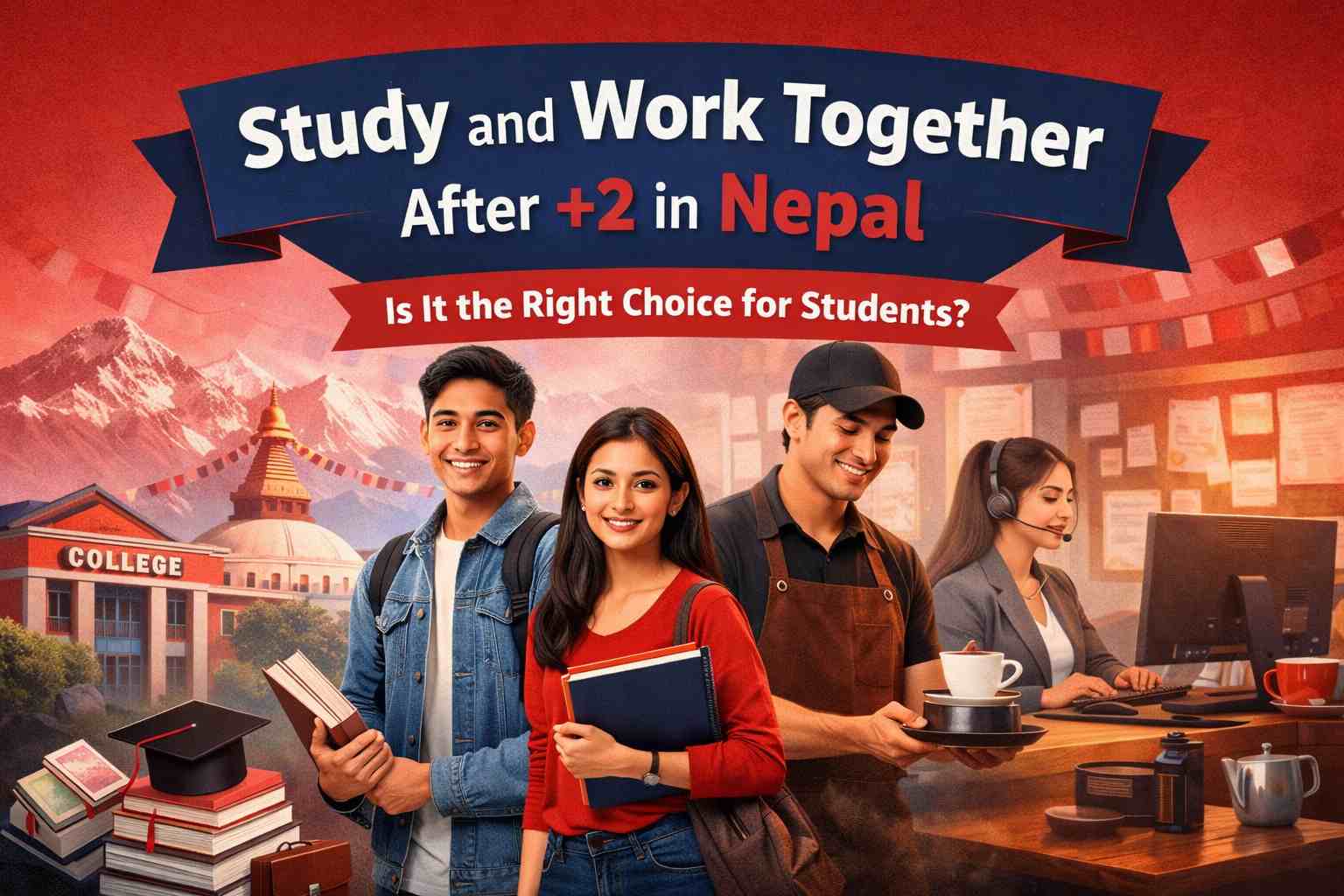
Study and Work Together After +2 in Nepal: Is It the Right Choice for Students?

After completing +2, many Nepali students face an important decision: should the focus be only on studies, or is it better to study and work at the same time?

With rising education costs, increasing competition, and early career pressure, studying and working together after +2 has become a popular option in Nepal. But is this path suitable for everyone?

This blog explains what studying and working side by side really means, its benefits, challenges, legal aspects in Nepal, and how to decide whether it is the right choice.

What Does Studying and Working Together After +2 Mean?

Studying and working together after +2 usually refers to:

  • Enrolling in a college or university program
  • Doing part-time jobs, internships, or flexible work alongside studies
  • Managing both academic responsibilities and work schedules simultaneously

In Nepal, this commonly includes:

  • Working in hospitality, retail, offices, IT support, or internships
  • Choosing courses with flexible class timings
  • Gaining real-world experience while continuing formal education

This approach is different from full-time employment and is mostly focused on earning experience and supporting expenses, not replacing education.

Why Many Nepali Students Choose to Work While Studying

Many students in Nepal choose to work after +2 for practical and personal reasons:

  • To support education expenses
  • To reduce financial pressure on family
  • To gain early work experience
  • To become independent and confident
  • To understand career interests before long-term commitment

For students from middle-income families, studying and working together often feels like a necessary and responsible decision, not just a choice.

Advantages of Studying and Working Side by Side After +2

When managed well, this path offers several benefits:

  • Earn while studying to manage personal and academic expenses
  • Gain practical skills alongside theoretical knowledge
  • Improve communication, teamwork, and time management
  • Build confidence and professional discipline early
  • Get clarity about career goals before graduation

Employers increasingly value experience, and students who work early often develop better workplace readiness.

Challenges Students Should Know Before Choosing This Path

Studying and working together is not easy. Students should be aware of the challenges:

  • Time management pressure between classes, assignments, and work
  • Risk of academic performance dropping
  • Physical and mental fatigue
  • Limited social or personal time
  • Poor job choices that do not add learning value

Ignoring these challenges can lead to burnout or incomplete education, which is why careful planning is essential.

Is It Legal to Work While Studying After +2 in Nepal?

Yes, working while studying after +2 is legal in Nepal.

There are:

  • No strict laws preventing students from part-time work
  • No specific student work-hour limits like foreign countries

However, students should:

  • Avoid unsafe or exploitative jobs
  • Choose ethical and skill-based work
  • Ensure work does not interfere with academic commitments

Parental guidance and institutional support play an important role here.

Best Courses After +2 for Students Who Want to Work

Not all courses are suitable for working students. Some programs naturally offer more flexibility and practical exposure.

Courses that work well with part-time jobs:

  • IT and Computer Science – flexible schedules, internships, freelance options
  • Business and Management – office jobs, internships, practical projects
  • Hospitality Management – industry exposure, shift-based work
  • International degree programs with structured academic planning

These courses focus on skill development, making work experience a valuable extension of classroom learning.

A Realistic Note: This Is Not for Every Student in Nepal

It is important to be clear about one thing.

This blog is NOT talking about students who must spend their entire day on studies, such as:

  • Students preparing for highly competitive entrance exams
  • Students in programs with heavy daily classes and lab hours
  • Students who already struggle academically and need full focus
  • Students with health, mental pressure, or family constraints

In Nepal, many students already have:

  • Long commuting hours
  • Packed class schedules
  • Academic pressure from family expectations

For such students, trying to work alongside studies can do more harm than good.

Who Should Choose Study and Work Together After +2?

This path is suitable for students who:

  • Are disciplined and self-motivated
  • Can manage time effectively
  • Have clear academic priorities
  • Want early career exposure
  • Are financially responsible

For such students, working while studying can be a smart long-term investment.

Conclusion: Is Studying and Working Together After +2 Right for You?

There is no one-size-fits-all answer.

Studying and working together after +2 in Nepal can be a great opportunity if:

  • The course is flexible
  • The work is meaningful
  • The student maintains academic focus

However, without proper planning and discipline, it can also become overwhelming. The right decision depends on personal goals, financial situation, course structure, and mindset.

Taking guidance from academic counselors and choosing the right institution and program can make this journey smoother and more rewarding.

Frequently Asked Questions (FAQs)

1. Can I work while studying after +2 in Nepal?

Yes – many students in Nepal do part-time work or internships while studying after +2. This can include jobs in cafes, retail stores, hospitality, or internships related to your field of study. However, not all students have enough free time to do so, especially those with heavy class schedules or long commute times.

2. What kinds of jobs can +2 students do while studying?

After +2, common part-time jobs in Nepal include:

  • Retail sales assistant
  • Waiter / barista
  • Customer service representative
  • Office support roles
  • Internships (field-specific)

Some students also try online work such as freelance projects.

3. Do part-time jobs help my studies?

Yes, if the work is related to what you study, it can reinforce learning and improve understanding. Students working in jobs related to their field often find they can apply classroom theory to real situations, which improves both academic performance and practical skills.

4. How much can a student earn while working in Nepal?

Earnings vary widely depending on the job. Some students reported working long days in hospitality or retail and earning modest monthly income, though this may not be enough to cover all expenses.

5. Will working affect my academic performance?

It can. Managing both work and studies is a challenge. If you take on too many hours or choose a demanding job, academic performance may drop, and fatigue can build up. Planning and time management are very important.

6. Is there a good environment for students to earn while studying in Nepal?

The environment for studying and earning in Nepal is still developing. Many students mention that steady, well-paid student jobs are not easy to find and that work opportunities are limited compared to some other countries.

7. Can I find work related to my future career while studying?

Yes – internships or field-related work help you build a resume. Internships in IT, business, or marketing fields are sometimes offered by companies and can give both income and experience.

8. Should every student try to study and work together?

No. Students with heavy academic schedules, competitive exam preparation, or health and family responsibilities may find it stressful and harmful to their studies. It works best for those who can manage their time, have flexible classes, and prioritize their goals.

The 10 Most In-Demand IT Careers for Nepali Students in 2026

Choosing the right career after +2 can feel confusing – especially when technology is changing so fast. New fields like Artificial Intelligence, Cybersecurity, and Data Science are growing rapidly, and students who prepare early can build strong, future-proof careers.

For Nepali students interested in Information Technology (IT), the coming years offer exciting opportunities – not only in Nepal but also in the global job market.

This guide explains the 10 most in-demand IT careers for 2026, in simple terms, and shows how students can start preparing right from college.

Why IT Is a Smart Career Choice for Nepali Students

Technology is now part of every industry – education, healthcare, banking, tourism, business, and government services. As companies continue to digitalise, the demand for skilled IT professionals keeps growing.

For Nepali students, IT offers:

  • High-demand career options
  • Opportunities to work globally
  • Strong salary potential over time
  • Flexible career paths (technical & creative)
  • Scope for freelancing and remote work

Starting IT education early – right after +2 – gives students a huge advantage.

Top 10 IT Careers That Will Be in Demand in 2026

Technology is evolving faster than ever, and the IT careers that will be most valuable in 2026 are already taking shape today. For students completing +2 and planning their future, understanding these roles early helps in choosing the right subjects, skills, and degree programs.

Below are the top 10 IT careers that are expected to remain in high demand globally and are also highly relevant for Nepali students.

1. Artificial Intelligence (AI) & Machine Learning Engineer

Artificial Intelligence (AI) and Machine Learning (ML) engineers work on systems that can learn from data and make decisions without being manually programmed. Examples include chatbots, voice assistants, recommendation systems (like YouTube or Netflix), and smart applications used in banking and healthcare.

These professionals design algorithms that allow machines to recognise patterns, predict outcomes, and improve over time. As AI becomes part of daily life – from mobile apps to business software – the need for skilled AI engineers continues to grow.

Why it’s in demand:

AI is now used in almost every industry, including education, finance, healthcare, e-commerce, and government services. Businesses rely on AI to automate tasks, reduce errors, and improve decision-making.

Good for students who enjoy:

  • Mathematics and logical thinking
  • Problem-solving
  • Coding and algorithms
  • Understanding how systems work

2. Data Analyst & Data Scientist

Data analysts and data scientists work with data to find useful insights. They analyse numbers, trends, and patterns to help organisations make better decisions. For example, they might analyse student performance data, business sales data, or customer behaviour.

While data analysts focus more on analysing existing data and creating reports, data scientists work on advanced models that predict future outcomes.

Why it’s in demand:

Every organisation today depends on data. Schools, hospitals, banks, businesses, and even government offices use data to improve efficiency and plan for the future.

Skills students can gradually learn:

  • Excel and spreadsheets
  • SQL for databases
  • Python for data analysis
  • Data visualisation tools

This career is ideal for students who enjoy working with numbers and finding meaning behind data.

3. Cybersecurity Specialist

Cybersecurity specialists protect computers, networks, and systems from cyber attacks. Their job is to keep data safe from hackers, malware, and online threats. This includes protecting websites, mobile apps, company databases, and even national digital systems.

They identify system weaknesses, monitor threats, and create security measures to prevent data loss.

Why it’s in demand:

As more services move online, cyber threats are increasing rapidly. From banks to colleges, every organisation needs cybersecurity professionals to protect sensitive information.

Good for students who like:

  • Ethical hacking
  • Understanding computer systems
  • Security and risk management
  • Critical and analytical thinking

Cybersecurity is also known for strong job security.

4. Software Developer (Full-Stack Developer)

Software developers create applications, websites, and digital systems. Full-stack developers work on both the front-end (what users see) and the back-end (how the system works behind the scenes).

They build everything from mobile apps and websites to enterprise software used by businesses and institutions.

Why it’s in demand:

Every digital product – apps, websites, platforms – needs developers. As technology continues to grow, software development remains one of the most stable IT careers.

Common technologies developers learn:

  • JavaScript
  • Python
  • Java
  • React
  • Databases

This career suits students who enjoy building things and seeing their work come to life.

5. Cloud Computing Engineer

Cloud computing engineers manage online servers and storage systems that run on the internet instead of physical computers. Platforms like AWS, Google Cloud, and Microsoft Azure are examples of cloud services.

These engineers help organisations store data, run applications, and scale systems efficiently without maintaining physical servers.

Why it’s in demand:

Most companies now rely on cloud platforms because they are cost-effective, flexible, and secure. Cloud computing has become the backbone of modern IT systems.

This role is ideal for students interested in infrastructure, systems, and modern computing environments.

6. DevOps Engineer

DevOps engineers help software teams work faster and more efficiently. They automate processes like testing, deployment, and system updates, ensuring software runs smoothly and reliably.

They act as a bridge between developers and IT operations teams.

Why it’s in demand:

Modern software development requires speed and stability. DevOps professionals help companies release updates faster without breaking systems.

Key skills involved:

  • Automation tools
  • System monitoring
  • Collaboration and communication
  • Cloud and server management

DevOps is suitable for students who enjoy both technical and teamwork-based roles.

7. UI/UX Designer

UI (User Interface) and UX (User Experience) designers focus on how digital products look and feel. Their goal is to make websites and apps easy to use, visually appealing, and user-friendly.

They design layouts, buttons, navigation flows, and overall user journeys.

Why it’s in demand:

A good user experience can make or break a digital product. Companies invest heavily in design to attract and retain users.

Good for creative students who enjoy:

  • Design and visuals
  • Problem-solving
  • Understanding user behaviour
  • Creativity with logic

This role combines creativity with technology.

8. IT Support & Systems Administrator

IT support professionals and systems administrators manage computer systems, networks, and hardware. They ensure that computers, servers, and software run smoothly within an organisation.

They handle troubleshooting, system maintenance, and user support.

Why it’s in demand:

Every organisation depends on reliable IT systems. Without proper support, daily operations can stop.

This role is often a strong entry point into the IT industry for beginners.

9. Network Engineer / Site Reliability Engineer

Network engineers design and manage internet and internal networks, ensuring fast and secure connectivity. Site Reliability Engineers (SREs) focus on system stability, uptime, and performance.

They ensure systems work efficiently even under high traffic or heavy usage.

Why it’s in demand:

Digital services depend on stable networks. Any downtime can lead to major losses, making these roles critical.

This career suits students interested in networking, systems, and performance optimisation.

10. AI Ethics & Data Governance Specialist

AI ethics and data governance specialists ensure that technology is used responsibly. They focus on data privacy, fairness, transparency, and ethical decision-making in AI systems.

As AI becomes more powerful, ethical concerns around data use and automation are increasing.

Why it’s growing:

Governments and organisations now require ethical guidelines for AI use. This role combines technology with social responsibility.

It is ideal for students interested in both technology and ethics.

What Skills Should +2 Students Focus On?

Students don’t need to know everything at once. The right foundation matters.

Key skills include:

  • Basic programming knowledge
  • Logical thinking & problem-solving
  • Communication & teamwork
  • Willingness to learn continuously
  • Understanding of real-world applications

Choosing the right college plays a major role in developing these skills.

Why Choosing the Right IT College Matters

A strong IT career doesn’t depend only on subjects – it depends on:

  • Practical learning
  • Industry exposure
  • Updated curriculum
  • Career guidance
  • Global education standards

This is where IIMS College stands out.

How IIMS College Helps Students Build a Career in IT

IIMS College offers IT and computer science programs designed to prepare students for real-world technology careers.

Students benefit from:

  • Industry-oriented curriculum
  • Practical learning approach
  • Exposure to international academic standards
  • Supportive learning environment
  • Career-focused education from day one

For students who want to study IT in Nepal while preparing for global opportunities, IIMS College provides a strong foundation.

Start Your IT Career Journey with Confidence

The future belongs to students who prepare early and choose wisely. IT careers offer long-term growth, flexibility, and global exposure – but success starts with the right education.

If you are a +2 graduate planning a career in IT, now is the right time to explore your options.

  • Explore IT programs at IIMS College
  • Talk to an academic counsellor
  • Take the first step toward a future-ready IT career

Frequently Asked Questions 

1. What are the most in-demand IT jobs that students should consider for the future?

Students are increasingly searching for careers in areas like Artificial Intelligence, Data Analytics, Cybersecurity, Cloud Computing, and Software Development because these roles are growing fast and are key parts of modern business systems worldwide.

2. What skills should +2 students learn to prepare for IT careers in 2026?

Foundational skills like coding (Python, JavaScript), data handling (SQL, Excel), basic cybersecurity practices, and cloud platform understanding (AWS, Google Cloud) are frequently searched as core skills that help students enter the IT field and keep up with market trends.

3. Will AI and automation replace IT jobs in the future?

Although AI and automation are transforming how tasks are done, they are expected to create more demand for skilled professionals who can build, maintain, and ethically manage these systems. Roles that combine human judgement and technical understanding remain crucial.

4. What entry-level IT jobs can beginners start with after +2?

Beginners often start with roles such as IT support technician, junior software developer, web developer, or data technician, which help build experience and open pathways to advanced roles like cloud engineer or cybersecurity specialist over time.

5. How is the job market for IT careers evolving globally and in Nepal?

Search trends show interest in core IT sectors – software development, data science, UX design, and cloud roles – as job markets expand with digital adoption. In contexts like Nepal, IT careers are growing both locally and internationally due to increased digitalisation across business and government services.

This is a demo version of our website. We’re in the process of making updates and enhancements. Stay tuned
Click to Apply for Counselling