







Upcoming Events

Recent Events

Why Practical Learning Matters More Than Marks in Today’s Job Market

For decades, academic marks were considered the main indicator of a student’s potential. High grades often meant better opportunities, respect, and career security. However, the modern job market has changed significantly. Today, employers are less focused on marks alone and more interested in what students can actually do in real-world situations.

Practical learning has become the key factor that separates job-ready graduates from those who struggle to adapt. This shift is especially important for students planning their careers after +2. In this blog, we will explore practical learning vs marks and understand what truly matters in today’s competitive job market.

1. The Changing Expectations of Employers

Employers today look beyond transcripts. While academic results still matter, they are no longer enough.

Recruiters now prioritize:

    • Problem-solving ability
    • Communication and teamwork
    • Technical and digital skills
    • Adaptability and learning mindset

Students who have worked on real projects, internships, or practical assignments often perform better in interviews than those with only theoretical knowledge.

2. Why Marks Alone Are No Longer Enough

Marks mainly measure how well a student understands theory and performs in exams. They do not always reflect:

    • How a student handles real challenges
    • How quickly they learn new tools
    • How effectively they work with others
    • How confident they are in practical situations

Many high-scoring students struggle when they enter the workplace because they are not used to applying knowledge in real scenarios.

3. What Practical Learning Really Means

Practical learning goes beyond textbooks and lectures. It includes:

    • Project-based learning
    • Case studies and real-world scenarios
    • Lab work and simulations
    • Internships and industry exposure
    • Presentations, teamwork, and problem-solving tasks

This approach helps students understand how their academic knowledge is used in real jobs.

4. How Practical Learning Builds Job-Ready Skills

Practical learning directly develops skills that employers value.

Key skills gained include:

    • Critical thinking and decision-making
    • Communication and presentation skills
    • Time management and responsibility
    • Technical and professional confidence

Students who experience hands-on learning adapt faster when they start working, reducing the gap between education and employment.

5. The Role of Colleges in Practical Education

Colleges play a vital role in preparing students for the real world. Institutions that focus on practical learning:

    • Integrate industry-relevant curriculum
    • Encourage internships and project work
    • Promote teamwork through clubs and activities
    • Provide exposure to real business and technology challenges

Such learning environments help students graduate with both knowledge and experience.

7. Balancing Marks and Practical Skills

Marks still matter, but they should not be the only focus. The most successful students are those who balance academic performance with skill development.

A strong combination of:

    • Decent academic results
    • Practical experience
    • Soft skills
    • Continuous learning

creates graduates who are truly job-ready.

Conclusion

The modern job market values ability over memorization. While marks provide a foundation, practical learning prepares students for real challenges, real workplaces, and real careers. For students planning their future after +2, choosing a learning path that emphasizes practical exposure can make a lasting difference.

Education today is not just about scoring high – it is about learning how to apply knowledge, adapt to change, and grow professionally.

Frequently Asked Questions About Practical Learning and Career Readiness

1. Why do employers value practical skills more than academic marks today?

Employers value practical skills because they show a student’s ability to solve real problems, work in teams, communicate effectively, and adapt quickly in a professional environment.

2. Can students start developing practical skills right after completing +2?

Yes, students can start developing practical skills immediately after +2 through project-based learning, internships, workshops, and skill-focused undergraduate programs.

3. Does practical learning reduce the importance of academic marks?

Practical learning does not replace academic marks. Instead, it complements academic performance by helping students apply theoretical knowledge in real-world situations.

4. How does practical learning help students become job-ready?

Practical learning helps students gain hands-on experience, build confidence, improve communication skills, and understand workplace expectations before entering the job market.

5. What should students look for in a college that focuses on practical learning?

Students should look for industry-aligned curriculum, project-based assessments, internship opportunities, experienced faculty, and active student clubs and activities.

6. What should students prioritize: practical learning or marks?

Both are important, but emphasizing practical learning vs marks ensures students not only perform well academically but also develop the skills needed to succeed in today’s competitive job market.
 

Business Degree in Nepal: BBA vs BBM vs BBUS – Which One Should You Choose?

Choosing the right business degree in Nepal after +2 can feel very confusing. With so many options, such as BBA, BBM, and BBUS, students often struggle to determine which program best matches their career goals.

Picking the wrong business degree in Nepal might waste years studying a program that does not provide the practical skills or international exposure needed today. Many colleges offer undergraduate business programs with varying recognition, adding to the confusion.

Some programs focus mainly on theory, while others combine practical learning and global standards. Without understanding these differences, students may struggle in the job market or miss opportunities abroad.

This guide from IIMS explains everything about BBA vs BBM in Nepal, introduces BBUS, and helps you choose the right Bachelor of Business in Nepal. After reading this, you’ll clearly understand which business degree courses align with your goals and future career.

BBA in Nepal – Bachelor of Business Administration

The Bachelor of Business Administration (BBA) is one of the most popular business degrees in Nepal programs. Many students choose BBA in Nepal because it offers a broad foundation in management and business administration.

What BBA Teaches You:

  • BBA course subjects in Nepal include marketing, finance, human resources, and operations
  • Develops leadership and strategic decision-making skills
  • Focuses on business administration course knowledge and practical exercises
  • Most programs last 4 years and follow a semester system

Why Students Choose BBA in Nepal:

  • Wide range of BBA colleges in Nepal
  • Recognized by local employers
  • Option to specialize in finance, marketing, or HR
  • Strong foundation for future MBA programs

Career Opportunities After BBA:

  • Management trainee positions
  • Marketing executives
  • Banking and finance roles
  • Business development officers

Despite its popularity, some students feel the BBA syllabus in Nepal focuses heavily on theory, limiting practical exposure in today’s competitive business world.

BBM in Nepal – Bachelor of Business Management

The Bachelor of Business Management (BBM) in Nepal focuses on developing strong management and operational skills. Compared to BBA in Nepal, BBM emphasizes leadership, project management, and organizational behavior.

Key Features of BBM in Nepal:

  • BBM course subjects in Nepal include operations management, project planning, and organizational behavior
  • Usually a 4-year program.
  • Offered by colleges affiliated with Tribhuvan University.
  • More management-focused than traditional business degree courses.

BBM vs BBA – Differences:

  • BBM in Nepal is management-centric
  • A BBA in Nepal offers broader business administration knowledge.
  • For recent graduates, BBM wages in Nepal range from NPR 25,000 to NPR 40,000.
  • Although BBM educates students for management-specific professions, career paths sometimes overlap.

Challenges:

  • Limited international recognition compared to newer programs like BBUS.
  • The BBM fee structure in Nepal varies from NPR 400,000 to NPR 800,000.
  • Less practical exposure in some colleges.
  • The job market treats BBA and BBM graduates similarly.

Students always ask, “Which is better, BBS or BBA?” BBM sits between these programs, offering more management focus than BBS but less global exposure than modern programs like BBUS.

The Modern Bachelor of Business Degree in Nepal: BBUS

The Bachelor of Business (Hons) or BBUS is a modern business degree in Nepal designed for students seeking international recognition and practical exposure. Unlike traditional BBA in Nepal or BBM in Nepal, BBUS combines local opportunities with global standards.

What Makes BBUS Unique:

  • Recognized internationally, ideal for global career opportunities.
  • Offered by the best colleges for business degrees, like IIMS College in partnership with Taylor’s University, Malaysia.
  • Focus on practical learning: internships, industry projects, and case studies.
  • Students can specialize in Digital Marketing, Finance, or Entrepreneurship.

Program Structure:

  • 3-4 years of study, including real-world projects
  • The modern BBUS syllabus covers digital business, analytics, and innovation.
  • Combines theoretical knowledge with practical business degree courses
  • Access to international faculty and a global curriculum

Career Opportunities with BBUS:

  • Positions in multinational companies
  • Entrepreneurship and startup ventures
  • International job placements.
  • Higher starting salaries compared to traditional programs.

BBUS is the perfect choice for students who want a Bachelor of Business in Nepal with global exposure, practical training, and strong career prospects.

Comparison Table – BBA vs BBM vs BBUS in Nepal

The table below compares BBA in Nepal, BBM in Nepal, and BBUS in Nepal to help students understand how each business degree in Nepal differs in focus, duration, fees, and career opportunities. This quick comparison makes it easier to choose the right Bachelor of Business in Nepal based on your goals, learning style, and plans.

Aspect BBA in Nepal BBM in Nepal BBUS in Nepal
Full Form Bachelor of Business Administration Bachelor of Business Management Bachelor of Business (Honours)
Duration 4 years 4 years 3–4 years
Focus Area Broad business administration course Management-focused International business practices
Recognition National National International & National
Starting Salary NPR 25,000–40,000 NPR 25,000–40,000 (BBM salary in Nepal) NPR 40,000–70,000
Practical Training Limited Limited Extensive
Global Opportunities Limited Very limited Excellent
Best For Traditional careers Management roles International careers
Example Colleges Multiple BBA colleges in Nepal TU-affiliated colleges IIMS College (Taylor’s University partner)

How to Choose the Right Business Degree in Nepal

Choosing between BBA, BBM, and BBUS depends on your career goals, learning preferences, and budget.

Choose BBA if:

  • You want a well-established business degree in Nepal
  • Prefer traditional education with many BBA colleges in Nepal.
  • Want to follow the standard BBA syllabus, recognized by employers in Nepal.
  • Looking for affordable business degree courses

Choose BBM if:

  • You are interested in management and operations
  • Prefer the BBM course in Nepal options through TU-affiliated colleges.
  • The budget aligns with the BBM fee structure in Nepal.
  • Want a management-focused business degree in Nepal.

Choose BBUS if:

  • You want international recognition for your Bachelor of Business in Nepal
  • Ready to invest in global opportunities
  • Prefer practical learning over purely theoretical business degree courses.
  • Plan to work abroad or in multinational companies.
  • Want to study at the best colleges for business degrees, like IIMS College.

Essential Factors to Consider:

  • Career aspirations (local vs international).
  • Budget and BBM fee structure in Nepal.
  • Learning style (theory vs practical).
  • Future studies (MBA or specialization).
  • Industry connections and placements.

Why IIMS College is the Best Choice for BBUS in Nepal

IIMS College is one of the best colleges for business degrees, offering BBUS in Nepal. It combines quality education, practical experience, and international recognition.

Key Advantages of IIMS College BBUS:

International Partnership

  • Collaboration with Taylor’s University, Malaysia (ranked #251 globally).
  • Globally recognized Bachelor of Business in Nepal.
  • Access to an international curriculum and teaching methods.

Practical Learning Opportunities

  • IIMS Biz Hub for hands-on business projects.
  • Industry visits to companies like Sipradi Trading.
  • Guest lectures from successful  Business persons.

Modern Infrastructure

  • Modern campus amenities.
  • E-library and digital learning resources.
  • Labs and collaborative areas for hands-on learning.

Student Support

  • Career counseling and placement support.
  • Clubs like Toastmasters and the Sports Club.
  • Alumni working in 450+ companies worldwide.
  • Regular networking and mentorship opportunities.

Academic Excellence

  • Scholarships for top performers.
  • Research and academic workshops.
  • Faculty with industry experience and international qualifications.

IIMS College ensures students get a business degree in Nepal that is globally relevant, practical, and career-ready.

Conclusion – Choosing the Right Business Degree in Nepal

Choosing between BBA, BBM, and BBUS depends on your goals and vision for the future. Traditional BBA in Nepal and BBM in Nepal are suitable for local careers, while BBUS offers global opportunities, practical skills, and higher employability.

The Bachelor of Business in Nepal’s landscape is evolving. Modern business degree courses, such as BBUS from leading business colleges, offer the ideal blend of theoretical knowledge, practical application, and global recognition.

Think carefully about your future study plans, learning style, budget, and job goals. Your future career success might be shaped by the business degree you choose today in Nepal.

Visit IIMS in Naxal, Kathmandu, or check our social media channels, including Facebook, Instagram, LinkedIn, YouTube, and TikTok, for the latest updates, and our website for admission details and Business course programs.

Frequently Asked Questions

1. Is a business degree a good choice for students in Nepal?

Yes, a business degree is a strong choice because it builds practical skills in management, leadership, and problem-solving that employers value. It also offers flexible career options in banking, marketing, entrepreneurship, and corporate roles.

2. What career opportunities are available after completing an undergraduate business degree?

Graduates can work in fields like marketing, finance, human resources, operations, or start their own business. Many students also continue their studies with an MBA or gain international work opportunities.

3. Which business course is considered the best to study today?

The best business course depends on your career goals, but programs with practical learning and international exposure tend to yield better outcomes. Modern degrees like BBUS focus more on real-world skills and global business trends.

4. Which business degree is ideal for a three-year duration?

A three-year business degree, such as BBUS, is ideal for students who want to enter the job market faster. It offers industry-focused learning while maintaining international academic standards.

5. How does an internationally affiliated business degree benefit students in Nepal?

An internationally affiliated business degree gives students global recognition and exposure to modern teaching methods. It also improves career opportunities in multinational companies and for further studies abroad.

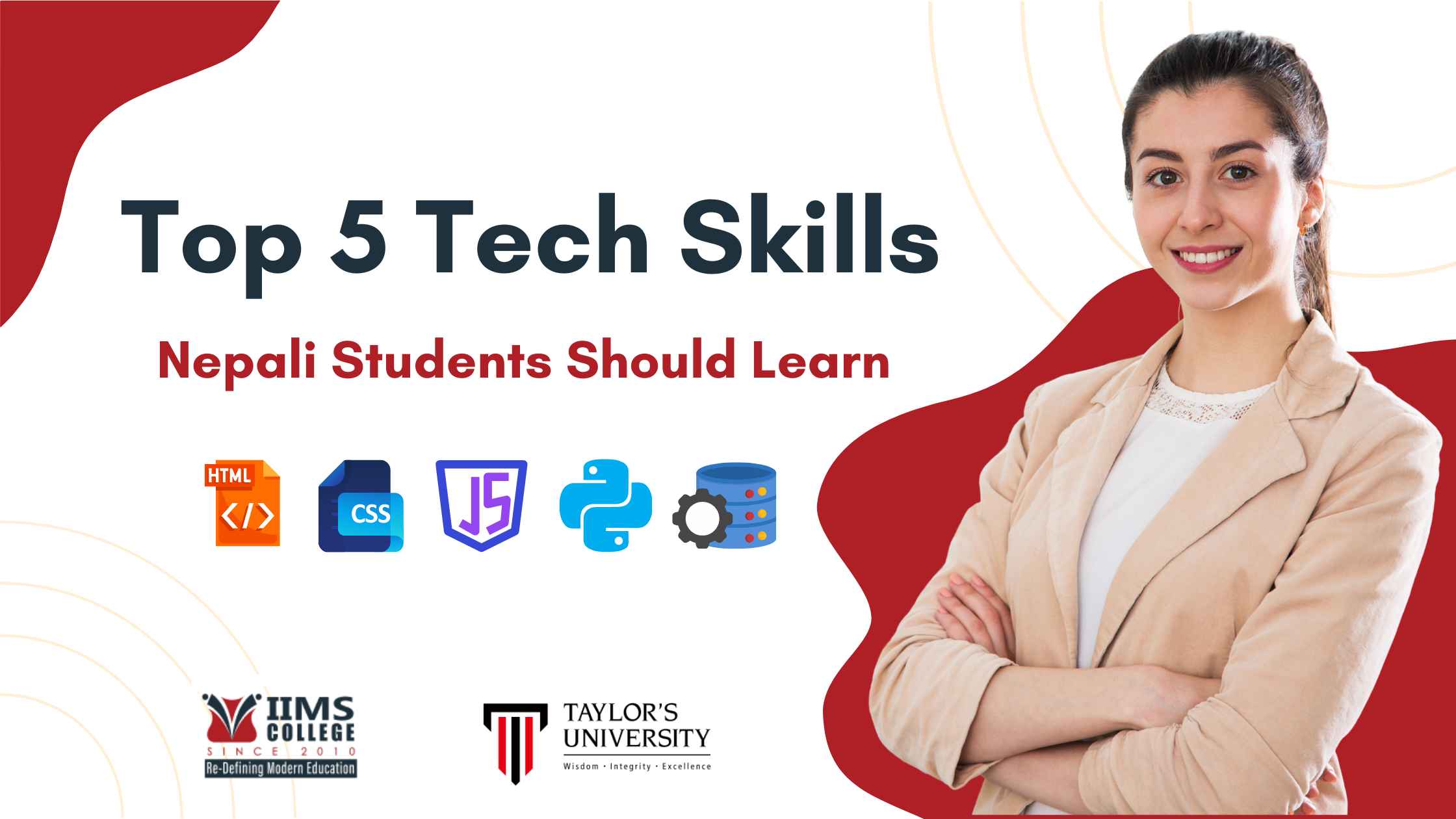
Top 5 Tech Skills Nepali Students Should Learn in 2026

The technology landscape is evolving faster than ever. For students in Nepal, understanding which skills are in demand is crucial to secure high-paying IT jobs in Nepal, access remote opportunities, and gain a competitive edge in the global market.

With Nepal’s IT sector expanding and digital transformation accelerating, it is important for students to focus on future-proof tech skills that are practical and aligned with real industry needs.

In this guide, we explore the top 5 tech skills Nepali students should learn in 2026, why they matter, and how you can start building expertise today.

1. Artificial Intelligence (AI) & Machine Learning (ML)

Artificial Intelligence and Machine Learning are transforming industries worldwide, and Nepal is no exception. From digital banking to IT startups, companies increasingly rely on AI to automate processes and analyze data.

Key Skills to Learn:

    • Python programming
    • Neural networks and deep learning
    • Data modelling and predictive analytics

Career Opportunities in Nepal:

    • AI Engineer
    • Machine Learning Engineer
    • Data Analyst
    • Automation Specialist

AI and ML are among the fastest-growing career paths globally. Students who develop these skills early can secure roles in both local IT companies and international remote opportunities.

How Students Can Learn Artificial Intelligence & Machine Learning

    • Take online beginner-friendly Python and ML courses (Coursera, Udemy, Google AI).
    • Practice building ML models using tools like TensorFlow or Scikit-learn.
    • Join AI communities in Nepal such as Fusemachines courses, AI clubs, or Kaggle competitions.
    • Work on small projects like prediction models, chatbots, or image classifiers.

2. Data Science & Analytics

Data is now the backbone of business decisions. Companies in Nepal – including banks, telecom operators, and startups – need data science professionals who can analyze trends, generate insights, and guide business strategy.

Skills to Focus On:

    • Python or R programming
    • SQL and database management
    • Data visualization using Tableau or Power BI

Job Roles:

    • Data Analyst
    • Business Intelligence (BI) Analyst
    • Data Scientist

Learning data science prepares students for high-demand IT jobs in Nepal and improves analytical and problem-solving skills, which are valuable in any career.

How Students Can Learn Data Science & Analytics

    • Enroll in online courses in Python/R, SQL, and data analytics.
    • Practice with real datasets from Kaggle.
    • Build dashboards using Power BI or Tableau.
    • Join data-focused workshops, internships, or analytics clubs in Nepal.

3. Cybersecurity & Ethical Hacking

With the rise of digital adoption, cyber threats are increasing in Nepal. Organizations require skilled professionals to protect networks, applications, and sensitive information.

Important Skills:

    • Network security
    • Penetration testing
    • Cryptography and cyber forensics

Career Opportunities:

    • Cybersecurity Analyst
    • Ethical Hacker
    • Security Consultant

Cybersecurity offers job security, career growth, and international opportunities, making it an essential skill for Nepali students pursuing IT careers.

How Students Can Learn Cybersecurity & Ethical Hacking

    • Start with basic networking (CompTIA Network+).
    • Learn ethical hacking fundamentals through EC-Council or online training.
    • Practice on platforms like TryHackMe and HackTheBox.
    • Join cybersecurity competitions and CTFs in Nepal.

4. Cloud Computing & DevOps

Cloud technology is transforming how businesses operate. Platforms like AWS, Microsoft Azure, and Google Cloud are widely adopted for storage, software development, and IT operations. DevOps integrates software development and IT operations for faster, reliable delivery.

Skills to Learn:

    • Cloud infrastructure basics (AWS, Azure, GCP)
    • Containerization (Docker, Kubernetes)
    • Continuous Integration/Continuous Deployment (CI/CD) pipelines

Job Opportunities:

    • Cloud Engineer
    • DevOps Engineer
    • System Administrator

With cloud computing and DevOps skills, Nepali students can access remote IT jobs, freelancing opportunities, and positions in multinational companies without leaving Nepal.

How Students Can Learn Cloud Computing & DevOps

    • Start with AWS Cloud Practitioner or Azure Fundamentals.
    • Practice deploying apps using Docker and Kubernetes.
    • Learn DevOps tools like GitHub Actions, Jenkins, and Terraform.
    • Build cloud-based projects like hosting websites or deploying microservices.

5. Web & Mobile App Development

Websites and mobile apps are essential for modern businesses. Startups, e-commerce platforms, and service providers require skilled developers to build and maintain digital solutions.

Technologies to Learn:

    • JavaScript, HTML, CSS
    • MERN Stack (MongoDB, Express.js, React, Node.js)
    • Flutter or React Native for mobile apps

Career Roles:

    • Full Stack Developer
    • Mobile App Developer
    • Freelance Developer

Mastering web and mobile app development opens doors to freelancing, entrepreneurship, and IT jobs in Nepal and abroad, making it a practical skill for students.

How Students Can Learn Web & Mobile App Development

    • Start with HTML, CSS, and JavaScript basics.
    • Build small web projects and progress to React or MERN stack.
    • Learn mobile development with Flutter or React Native.
    • Create portfolio projects and contribute to open-source repositories.

Conclusion

The IT job market in Nepal and internationally is rapidly evolving. By focusing on the top 5 tech skills – AI & ML, Data Science, Cybersecurity, Cloud Computing, and Web/Mobile Development – Nepali students can secure rewarding careers that are future-ready and high-demand.

Start learning early, practice consistently, and gain practical experience through projects, internships, or competitions. With dedication, you can build a career that not only meets the demands of today but remains relevant for years to come.

Take the first step toward a successful tech career – explore IT programs and courses that provide practical skills, hands-on learning, and opportunities for internships in Nepal.

FAQs About Top Tech Skills for Nepali Students

1. Which tech skill is easiest to learn for Nepali students starting out?

Web & mobile app development – especially learning HTML, CSS, JavaScript and a simple framework – is often the easiest entry point. It involves fewer prerequisites and lets you build projects quickly, making it ideal to start your IT journey in Nepal.

2. Can I get an IT job in Nepal without a Bachelor’s degree if I have practical skills?

Yes – many employers in Nepal value practical skills, project portfolios, and certifications more than just the degree. For roles like web development, mobile apps, or even data analysis, demonstrable skills and real‑world projects can help you land a job.

3. Are remote IT jobs available for Nepali students with these tech skills?

Definitely. With skills like cloud computing, full‑stack development, data science, and cybersecurity, Nepali students can apply for remote jobs for foreign firms, because much of IT work can be done online – allowing global opportunities from Nepal.

4. How long does it typically take to become job‑ready after starting to learn a new tech skill (e.g. AI, data science)?

It depends on your consistency and practice. For many in-demand skills – like web/mobile development or data analytics – a dedicated 6-12 months of learning, building small projects, and practical practice can make you ready for entry-level roles.

5. Which programming languages or technologies are most demanded by Nepali employers in 2025–26?

Employers often seek developers familiar with Python (for data, AI, backend), JavaScript and frameworks like MERN Stack / React / Node (for web), and cloud technologies (AWS / Azure / Google Cloud) or DevOps skills.

6. Is cybersecurity a good career choice in Nepal, considering demand and growth?

Yes – as digitalization, online transactions, and data handling increase in Nepal, demand for cybersecurity professionals is rising. Security analysts, ethical hackers, and experts in network security can expect stable jobs and growth opportunities.

7. Do I need strong maths or science background to pursue AI / Data Science / Machine Learning in Nepal?

Basic mathematics and logical thinking help, but you don’t need to be a maths expert to start. Fundamentals like Python programming, data handling, and analytical thinking are more important – with advanced math being helpful but not always mandatory.

8. Can fresh +2 graduates (or first‑year students) start learning these skills now and still build a good IT career?

Absolutely. Many students start learning tech skills alongside their studies. Building a portfolio with small projects, internships, or freelance work greatly improves chances of landing good jobs even before graduation.

9. What soft skills should Nepali students develop along with tech skills to improve job chances?

Apart from technical skills, employers in Nepal value good communication, problem-solving, teamwork, English proficiency (especially for remote jobs), and ability to handle real-world projects. These soft skills often make a big difference in hiring decisions.

10. Which tech skill offers the best balance between demand, salary, and ease of learning in Nepal right now?

Web & mobile app development – combined with basic backend or cloud understanding – offers perhaps the best balance. Demand is high, entry is easier compared to advanced fields, and it can lead to freelancing, remote jobs, or full-time roles.

The Scope of Bachelor’s in Business (BBUS) in Nepal

It’s exciting to finish your +2. However, picking the best profession route might be difficult. You are looking for a degree that will provide you with practical skills, real opportunities, and a bright future. This is exactly what a bachelor’s in business provides: a gateway to endless possibilities.

The job markets are evolving rapidly. Traditional education often doesn’t prepare students for modern business challenges. Companies need graduates who can adapt, innovate, and lead. A Bachelor of Business in Nepal (BBUS) bridges this gap perfectly.

At IIMS College, partnered with Taylor’s University Malaysia, the BBUS program ranks among the world’s top 150 for Business and Management Studies. This isn’t just any business studies Nepal program-it’s your launchpad for global success. Whether you dream of entrepreneurship, corporate leadership, or international careers, BBUS equips you with everything needed.

Let’s explore how this program shapes your future with practical skills, exciting specializations, and incredible career opportunities.

What is BBUS? Understanding Business Course in Nepal 

The Bachelor of Business in Nepal (BBUS) at IIMS is an internationally recognized honors degree. Unlike traditional BBS programs, BBUS follows global standards through its partnership with Taylor’s University.

Program Highlights:

  • Duration: 4 years full-time program.
  • Global Recognition: Ranked Top 150 worldwide for Business & Management.
  • Study Options: Study in Nepal with transfer options to Australia or the UK.
  • Practical Focus: Real projects, internships, and industry exposure.

What Makes BBUS Different?

This business course in Nepal combines academic excellence with hands-on learning for a bachelor’s in business. You won’t just memorize theories; you will apply them. The curriculum covers:

  • Management fundamentals and strategic planning.
  • Marketing strategies and consumer behavior.
  • Financial planning and corporate finance.
  • Human resource management.
  • Entrepreneurship development.
  • International business practices.

Method of Learning:

IIMS uses innovative teaching methods. Expect group discussions, Real life case studies, business simulations, and management training sessions. Guest lectures from industry leaders give you insider perspectives.

Flexible Education Component:

You can choose minors in areas like:

  • Digital marketing and advertising.
  • Information technology and web development.
  • Psychology and organizational behavior.
  • Mass communication and public relations.
  • Project management and business analytics.

This bachelor’s in business program prepares you for both entrepreneurship and corporate careers. The holistic curriculum ensures you are ready for any business challenge globally.

Essential Skills You Will Develop

  • Problem-Solving Skills.
  • Critical Thinking Business.
  • Entrepreneurship Skills.
  • Management Training.

These skills make you valuable in any industry. IIMS ensures you graduate confident and career-ready through practical business skills development throughout four years.

Opportunities for Careers and Future Development

Completing your Bachelor of Business in Nepal opens incredible career doors.

Career Paths in Companies:

  • Management Trainee: Start your career at top companies like Unilever or Chaudhary Group. You’ll rotate through different departments, learn how the whole business works, and get trained to become a future manager.
  • Marketing Executive: Create ads, manage social media, and help sell products. You’ll think of creative ways to attract customers and make brands popular in the market.
  • Financial Analyst: Work with money and numbers in banks or investment firms. You’ll help companies understand their finances and make smart decisions about where to invest their money.
  • Business Consultant: Help businesses solve their problems and grow bigger. You’ll study what they’re doing wrong, suggest better ways to work, and guide them to success.
  • HR Professional: Take care of employees in a company. You’ll hire new people, train them, solve workplace problems, and make sure everyone is happy and productive at work.
  • Product Manager: Bring new products to life from start to finish. You’ll figure out what customers want, work with teams to create it, and make sure it sells well in the market.
  • Operations Manager: Make sure everything in a business runs smoothly every day. You’ll organize work processes, manage teams, cut unnecessary costs, and keep customers satisfied with quality service.

Entrepreneurship Routes:

Your entrepreneurial abilities enable you to start:

  • Internet retailers and e-commerce companies.
  • Social media and digital marketing firms.
  • App development and tech startups.
  • Business consulting firms.
  • Import and export trading ventures.
  • Social enterprises solving community problems.

International Opportunities:

IIMS graduates work globally in:

  • Middle East countries (Dubai, Qatar, Saudi Arabia).
  • Australia and the United Kingdom.
  • Southeast Asian nations (Singapore, Malaysia).
  • International NGOs and development organizations.

Future Scope:

Nepal’s economy is growing rapidly. Emerging opportunities in:

    • Fintech and digital banking solutions.
    • E-commerce and online marketplaces.
    • Renewable energy and green businesses.
    • Healthcare management and medical tourism.
    • Tourism, hospitality, and adventure travel.

    The business course in Nepal ensures you’re prepared for whatever comes next. Many graduates also pursue MBA programs with international scholarships.

    Specializations at IIMS College

    Your bachelor’s in business(BBUS) journey includes choosing a specialization course in Year 3. IIMS offers six industry-aligned options:

     Finance: 

    Perfect for those who love working with numbers:

    • Corporate finance and investment strategies.
    • Derivatives and risk management.
    • International finance and forex markets.
    • Fintech innovations and digital banking.
    • Applied econometrics and financial modeling.

     Management: 

    Leadership-focused curriculum:

    • Strategic management and planning.
    • Leadership and change management.
    • Ethics and corporate governance.
    • Sustainable supply chain management.
    • Transnational management practices.

    Global Business and Sustainability:

    International career preparation:

    • International business issues and policies.
    • Export practices and management.
    • Social entrepreneurship and ethics.
    • Sustainable business operations.
    • Cross-cultural management.

    Digital Marketing and Analytics:

    Tech-driven marketing focus:

    • Big data and data analytics essentials.
    • Market intelligence and visualization.
    • Social media marketing and analytics.
    • Interactive and digital marketing.
    • Marketing analytics and consumer insights.

    Marketing:

    Traditional and modern marketing:

    • Consumer behavior and psychology
    • Integrated marketing communications
    • Services marketing and branding
    • E-commerce and digital strategies
    • Marketing analytics and research

    Digital Business and Transformation:

    Future-ready business skills:

    • E-commerce platform management.
    • Digital transformation strategies.
    • Leadership in digital change.
    • Sustainable supply chain technology.
    • Business process innovation.

    Select Your Own Path:

    Consider your interests and career goals. Love analyzing data. Pick Digital Marketing and Analytics. Passionate about sustainability. Choose Global Business. Dream of leading teams. Management is ideal. The specialization course includes:

    • Hands-on projects and case studies.
    • Industry internships and exposure.
    • Entrepreneurship accelerator projects.
    • Real business problem-solving.

    IIMS ensures your business studies in  Nepal experience combines theory with practical application, making you industry-ready from day one.

    Why Choose BBUS At IIMS Taylor’s?

    IIMS College offers Nepal’s premier business course with unique advantages:

    Global Recognition:

    • Taylor’s University ranks in the Top 50 globally for Marketing.
    • Top 150 for Business and Management Studies.
    • One private university in Malaysia and Southeast Asia.
    • Internationally accredited Bachelor of Business degree in Nepal.

    Overseas Transfer Options: 

    Study 1-2 years at IIMS, then transfer to:

    • University of Queensland, Australia.
    • University of Bristol, UK.
    • RMIT Melbourne.
    • University of Essex.
    • UNSW Sydney.
    • University of Adelaide.

    Modern Infrastructure:

    • Smart classrooms with the latest technology.
    • Well-equipped computer and business labs.
    • Comprehensive library resources.
    • Project collaboration and innovation spaces.
    • Professional networking areas.

    Industry Connections:

    • Regular internships with the top Nepali and international companies.
    • Guest lectures from business leaders and entrepreneurs.
    • Networking opportunities with alumni.
    • Campus recruitment drives from leading firms.

    Scholarship Opportunities:

    • Merit scholarships up to 75% tuition waiver.
    • Sports scholarships up to 100% coverage.
    • Talent (non-sports) scholarships available.
    • Community service scholarships.
    • Academic excellence awards up to NPR 50,000.

    Real World Lessons:

    • Business simulations and case competitions.
    • Social innovation projects address real problems.
    • Entrepreneurship accelerator programs.
    • International study tours and exposure.
    • Industry immersion modules.

    The comprehensive management training and focus on problem-solving skills make IIMS graduates highly employable globally.

    Conclusion

    A business course in Nepal at IIMS-Taylor’s opens doors to endless possibilities. This bachelor’s in business program doesn’t just give you a degree-it transforms you through exceptional business skills development. You’ll graduate ready to lead, innovate, and succeed in any industry.

    Stay connected with IIMS College for the latest updates, student success stories, events, and program information. Visit our social media platforms, such as Facebook, Instagram, YouTube, LinkedIn, and TikTok, for the latest updates. Get insider access to campus life, hear from alumni, and stay informed about admission deadlines and scholarship opportunities.

    Your future starts now-don’t wait, apply today and become part of Nepal’s premier business education family!

    Frequently Asked Questions

    1. 1. Which course is best for doing business?

    The Bachelor of Business (BBUS) at IIMS-Taylor’s is ideal as it offers six specializations, including Finance, Marketing, and Digital Business. This internationally recognized program ranks in the world’s Top 150 for Business and Management Studies.

    1. 2. What are the entry requirements?

     You need a minimum of 50% marks or 2.0 CGPA in SEE and +2/NEB, or equivalent international qualifications. Additional documents include academic transcripts, character certificates, and proof of English proficiency.

    1. 3. Can I transfer to another university in another country?

    Yes, IIMS offers overseas transfer options to top universities in Australia and the UK after 1-2 years. Partner institutions include the University of Queensland, the University of Bristol, RMIT Melbourne, and the University of Essex.

    1. 4. What scholarship opportunities are available?

    IIMS offers multiple scholarships, including merit (up to 75%), sports (up to 100%), and talent-based scholarships. Academic excellence scholarships of up to NPR 50,000 are also available for qualifying students.

    1. 5. How long is the BBUS program?

    The Bachelor of Business program is a 4 year full time degree with options to specialize. The program includes mandatory internships and industry immersion modules for practical experience.

This is a demo version of our website. We’re in the process of making updates and enhancements. Stay tuned
Click to Apply for Counselling