





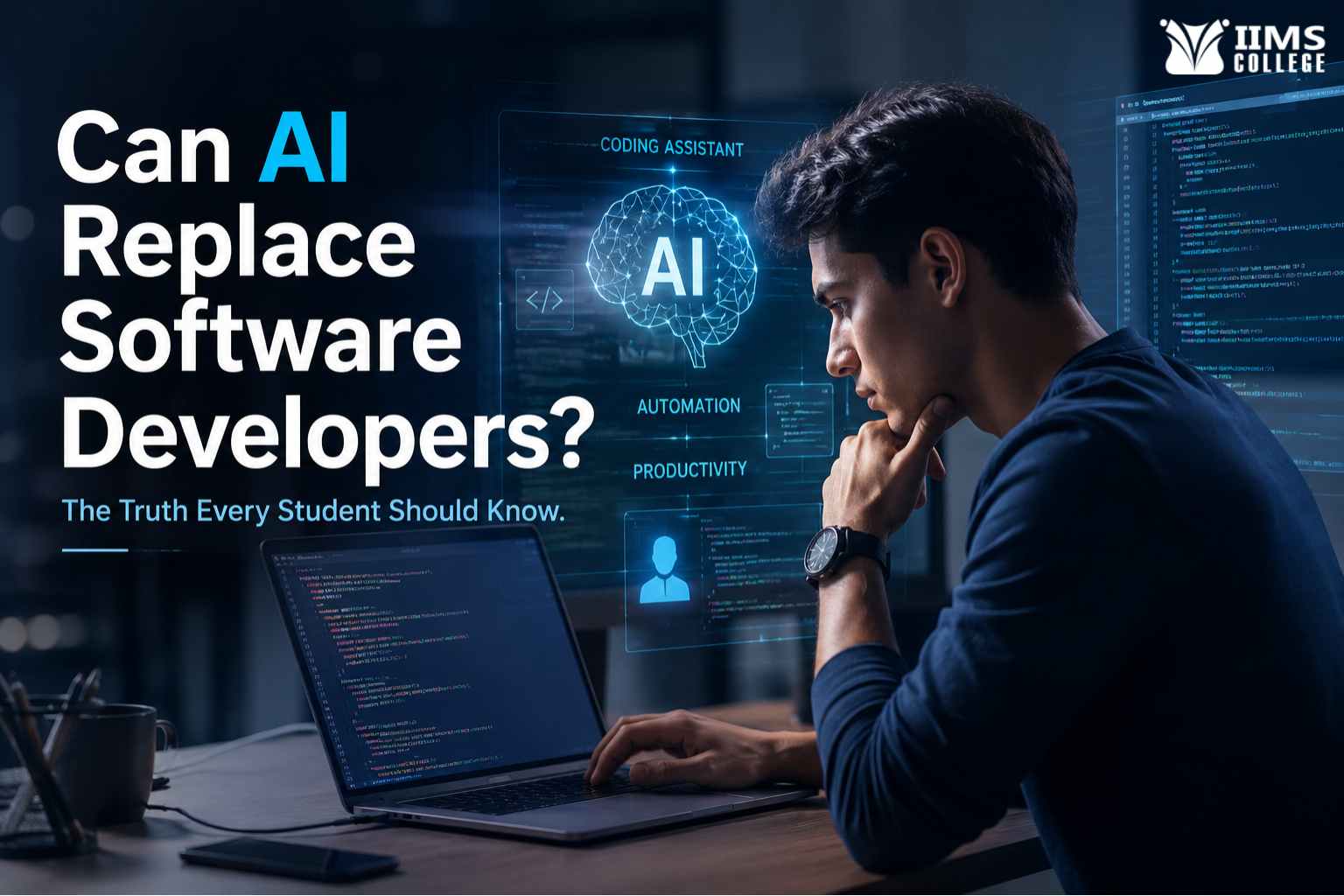
You just finished your +2 science with Computer Science, and now a big, scary question is floating in your head. Every week, you see headlines like “AI writes code better than humans,” and it feels like your dream software developer career might disappear before it even starts. That is a real worry, and you are not alone.
Your parents invested in your education. You have been dreaming of a career as a software developer. But now every news article, every YouTube video, every social media post seems to say the same thing: “AI is coming for programmers.” Should you switch fields? Is studying computer science after +2 even worth it anymore?
Here is the good news. The answer is NO, AI cannot replace software developers. But it will absolutely change what they do. By the end of this blog, you will know exactly why, what skills you need, and why the scope of computer science in Nepal has never been more exciting. Let us dig in.
What Is AI Actually Doing in Software Development?
Before we panic, let us understand what AI and software development really look like together right now. Think of AI as a super-smart autocomplete one that can write chunks of code, suggest fixes, and even spot bugs. Tools like GitHub Copilot, ChatGPT, and Google Gemini can write working code in seconds.
Sounds scary? Here is the thing, this is the same way a calculator did not replace mathematicians. It made them faster and more powerful. That is exactly what AI is doing with programmers today.
Think of it this way: When a carpenter gets a power drill, they do not lose their job. They build more houses, faster. AI tools are the power drills of AI and software development.
Here is what AI can actually do in coding today:
- Write repetitive or simple code, like loops and basic functions
- Suggest code completions as you type
- Detect bugs and offer fixes
- Convert the code from one programming language to another one.
- Generate unit tests automatically
And here is what AI still cannot do:
- Understand a client’s real business problem and translate it into a working solution
- Design a full software architecture from scratch with creative judgment
- Manage a team of people, timelines, and communication
- Make ethical decisions about data, privacy, and users
- Build trust with clients through human relationships
Can AI Replace Software Developers? The Real Answer
AI will not replace developers. But developers who use AI will replace developers who don’t. A widely shared principle in the tech industry, 2025
So, can AI replace software developers? The honest, research-backed answer is: No, not fully, and not anytime soon.
Let us look at the numbers:
- 25% of software tasks AI can automate today
- 4 million plus new software jobs expected globally by 2030
- Developers with AI tools code 2x faster
- AI skilled developers earn 40% higher salaries on average
The question: Will AI replace programmers?assumes that programming is just about typing code. But a software developer’s job is actually about solving human problems. The code is just one part of it.
Think about a doctor they use X-ray machines and diagnostic AI now, but the doctor’s job is more important than ever. The same logic applies to the question of whether AI will replace software engineers in the future. Engineers will use AI as a tool, not be replaced by it.
What AI will replace:
- Copy and paste coding tasks
- Writing boilerplate code
- Simple data formatting
- Basic documentation drafts
- Finding syntax errors
What developers still own:
- System architecture design
- Understanding user needs
- Creative and problem solving
- Team leadership and mentorship
- Ethical technology decision-making
The answer to “Can AI replace software developers?” is no. AI is a tool, not a replacement. Developers that master the use of AI as a superpower will prosper.
Scope of Computer Science in Nepal After +2
Now, let us talk about something that is directly important to you, the scope of computer science in Nepal. Many students and parents worry that Nepal’s tech market is too small. But here is what is actually happening on the ground.
The IT industry in Nepal is expanding at a rate of more than 15% annually. Businesses based in Kathmandu that cater to clients worldwide include Leapfrog Technology, Fusemachines, Verisk Nepal, and CloudFactory. Additionally, Nepali developers now have full access to the global job market thanks to remote work following COVID:19.
Here is what you can do after +2 computer science:
- BSc CSIT (Bachelor of Science in Computer Science and Information Technology): The most popular choice, offered by Tribhuvan University across Nepal.
- BIT (Bachelor of Information Technology): A practical, industry-focused degree that prepares you for the job market faster.
- BCA (Bachelor of Computer Applications): Great balance of computer science theory and application development.
- BE Computer Engineering: The most technical path, great for those who want to go deep into hardware, AI, and systems.
- International Programs: With scholarships and entrance exams, Nepali students are gaining admission to IITs, US universities, and European programs every year.
If you are looking for an internationally recognized path, the Bachelor of Computer Science (Honours) at IIMS College, affiliated with Taylor’s University, Malaysia, is one of the strongest options available in Nepal. The BCS program is designed specifically for students who want a global-standard CS education without leaving Nepal. You can learn more about it here: Bachelor of Computer Science (Honours)
The field of computer science in Nepal has expanded beyond Kathmandu. You can make money in USD while sitting in Pokhara or Dharan by working remotely on sites like Upwork and Toptal. After +2, computer science truly opens doors around the world.
Nepal produces 5,000-plus IT graduates per year, yet demand for skilled developers still outpaces supply both locally and globally. Studying computer science after +2 puts you ahead of the curve.
AI Career Opportunities You Should Know About
Here is the exciting part: AI career opportunities are exploding right now. AI did not just come to take jobs. It created a whole new category of careers that did not exist 10 years ago.
If you are a student in Nepal thinking about AI career opportunities, here are the real roles waiting for you:
- Machine Learning Engineer: You build and train the AI models that power products. The average global salary is $120,000 plus per year.
- Data Scientist: You analyze data to find patterns and help companies make smart decisions. Huge demand in banks, hospitals, and e-commerce.
- AI Product Manager: You bridge the gap between what AI can do and what businesses need. No deep coding required, but a CS background helps a lot.
- NLP Engineer (Natural Language Processing): You build chatbots, voice assistants, and language models. One of the fastest-growing AI career opportunities right now.
- AI-Assisted Full Stack Developer: A traditional software developer career upgraded with AI tools to build products two to three times faster.
- Cybersecurity AI Specialist: Using AI to detect and prevent cyberattacks. Critically important as the digital world grows.
- Robotics and Automation Engineer: Designing AI systems for physical machines and factories.
The best part? You do not have to choose between a software developer career and an AI career. Today, the two are the same thing. Modern developers are expected to know and use AI tools as part of their daily work.
Fusemachines, based in Kathmandu, is a global AI company hiring Nepali talent directly. Companies like these prove that AI career opportunities exist right here at home.
What Skills Will Future Software Developers Need?
As AI and software development merge, the skill set expected in a software developer career is evolving. The good news? These are skills you can start learning right now, even before university.
Here is a skill map for the future:
- Learn a core language deeply: Python is the number one choice for AI and software development. It is beginner-friendly and powers almost every AI tool in the world.
- Understand AI fundamentals: You do not need a PhD. Knowing what machine learning, neural networks, and large language models are will give you a massive edge.
- Get comfortable with AI coding tools: GitHub Copilot, ChatGPT Code Interpreter, and Cursor AI are tools top developers use daily. Learn them early.
- Learn Data Structures and Algorithms: This is still the backbone of every software developer’s career and every technical interview.
- Communication and Problem-Solving: Companies hire developers who can explain their code, collaborate in teams, and understand business goals. AI cannot fake this.
- Build real projects: A GitHub portfolio with actual apps you have built is worth more than 10 certificates in Nepal’s job market.
- English proficiency: The global tech world runs on English. Strong reading and writing skills open up remote jobs and international opportunities.
This is exactly the kind of environment IIMS College creates through its IIMS Hackathon and Project Showcase, where BCS students build and present real projects to industry professionals. It is not just classroom learning; it is hands-on practice that builds your portfolio while you are still studying.
For students in Nepal: Platforms like Coursera, edX, freeCodeCamp, and the Fusemachines AI Fellowship (Nepal-based) are accessible and often free. Start building skills alongside your college degree.
Will AI Replace Software Engineers in the Future? A 10-Year Outlook
Let us fast-forward and look honestly at what is coming. Will AI replace software engineers in the future, say, by 2035? Here is a realistic picture.
By 2028:
- AI writes around 50% of all basic code. Tools like GitHub Copilot are already giving us a preview of what 2028 and beyond will look like.
- AI reviewers and supervisors replace junior developers in these jobs.
- The number of new positions in AI prompt engineering is expanding quickly.
- Developers with AI expertise get more money.
By 2035:
- AI handles most routine coding tasks fully
- Senior developers focus on architecture and ethics
- Demand for AI specialists increases three times over
- Hybrid human plus AI teams become the standard
Notice: what is happening: jobs are not disappearing. They are transforming. The question is not “will AI replace programmers” but rather which programmers will thrive in an AI-powered world.
The answer: programmers who are curious, adaptable, creative, and willing to keep learning. Those are qualities AI cannot replicate, and they are qualities students like you can develop right now.
The only developers at real risk are those who refuse to learn new tools. Developers who ignore AI and software development trends, not those who embrace them, are the ones who may struggle. Do not be that person.
Why a Software Developer Career Is Still a Smart Choice in 2026
Let us be very clear, choosing a software developer career today is one of the smartest decisions you can make as a student. Here is why the scope of computer science in Nepal and globally remains exceptionally bright:
- Job security is high: Software developer jobs are projected to grow 25% through 2032, much faster than the average for all professions.
- Remote work is the norm: A Nepali developer can earn a US-level salary from Kathmandu. This was rare five years ago. Now it is completely normal.
- AI multiplies your output: A developer with AI tools today can do the work that used to require a team of three or four people. That means you are more valuable, not less.
- Nepal’s digital economy is growing: e-governance, fintech such as eSewa and Khalti, healthtech, and edtech are all driving massive demand for local developers.
- Low barrier, high ceiling: You do not need expensive equipment or a perfect GPA. A laptop, an internet connection, and determination can get you started on a software developer career path today.
The scope of computer science in Nepal extends far beyond coding jobs. CS graduates go on to become startup founders, product managers, digital marketers, UX designers, and policy advisors. The degree opens dozens of doors.
Conclusion: Choose Your Career With Confidence
Let us bring it all together. Can AI replace software developers? No, and here is the one thing to remember from this entire blog: AI is the best tool ever given to software developers. It does not replace them. It empowers them.
The answer indicates in the same direction whether you are concerned about whether AI will replace programmers, uncertain about the extent of computer science in Nepal, or trying to figure out what to do after +2 computer science. Put in a lot of study time, learn AI tools, work on real projects, and embrace the future.
The AI career opportunities ahead of you are bigger than any generation of students has ever seen. A career as a software developer in 2026 and beyond is not just safe; it is exciting, well-paying, globally relevant, and deeply meaningful.
The future is not coming for your career. Your career is the future. Go build it.
If you are a +2 graduate in Nepal ready to take that first step, IIMS College’s Bachelor of Computer Science (Honours) program is built for exactly this future, where AI tools, real projects, and a global curriculum come together. Check out the Level Up After +2 page to see how IIMS prepares students for the careers described in this blog.
Frequently Asked Questions
1. Will AI Replace Computer Programmer Jobs?
No, AI can manage boring coding chores, but it is unable to lead teams, think creatively, or resolve actual business issues. Learning to use AI technologies will actually make programmers more useful rather than less. The work is evolving, not going away.
2. Which Country Is Number 1 in Coding?
China leads in competitive programming and graduate output. The US leads in innovation and tech products. But here is something worth knowing: Nepal ranked 2nd globally in Meta’s Bug Bounty program in 2024, indicating that Nepali developers are already competing at the global level.
3. What Is the Best Job for AI Students?
Machine Learning Engineer is the top pick right now, with high demand, strong salary, and growing fast. But the best job is honestly the one that matches how your brain works:
- Love numbers and patterns: Data Scientist
- Love building apps: AI Full Stack Developer
- Love language: NLP Engineer
- Love security: AI Cybersecurity Specialist
- Love business over coding: AI Product Manager
Pick your strength first. The salary follows.
4. Which 5 Jobs Will Remain After AI?
These five are safe and growing:
- Software Developers and AI Engineers: Someone has to build AI itself
- Doctors and Healthcare Workers: Human judgment saves lives, AI cannot replace that
- Teachers and Educators: Inspiration and mentorship are deeply human
- Creative Professionals: Real creativity comes from lived human experience
- Skilled Trades, Electricians, Plumbers, Builders: Physical, unpredictable work, AI still cannot do
5. Is computer science after +2 still worth it?
Definitely. One of the most future-proof educational options for Nepali students is computer science after +2. The need for experts in technology, system development, and responsible AI development is growing along with AI.


